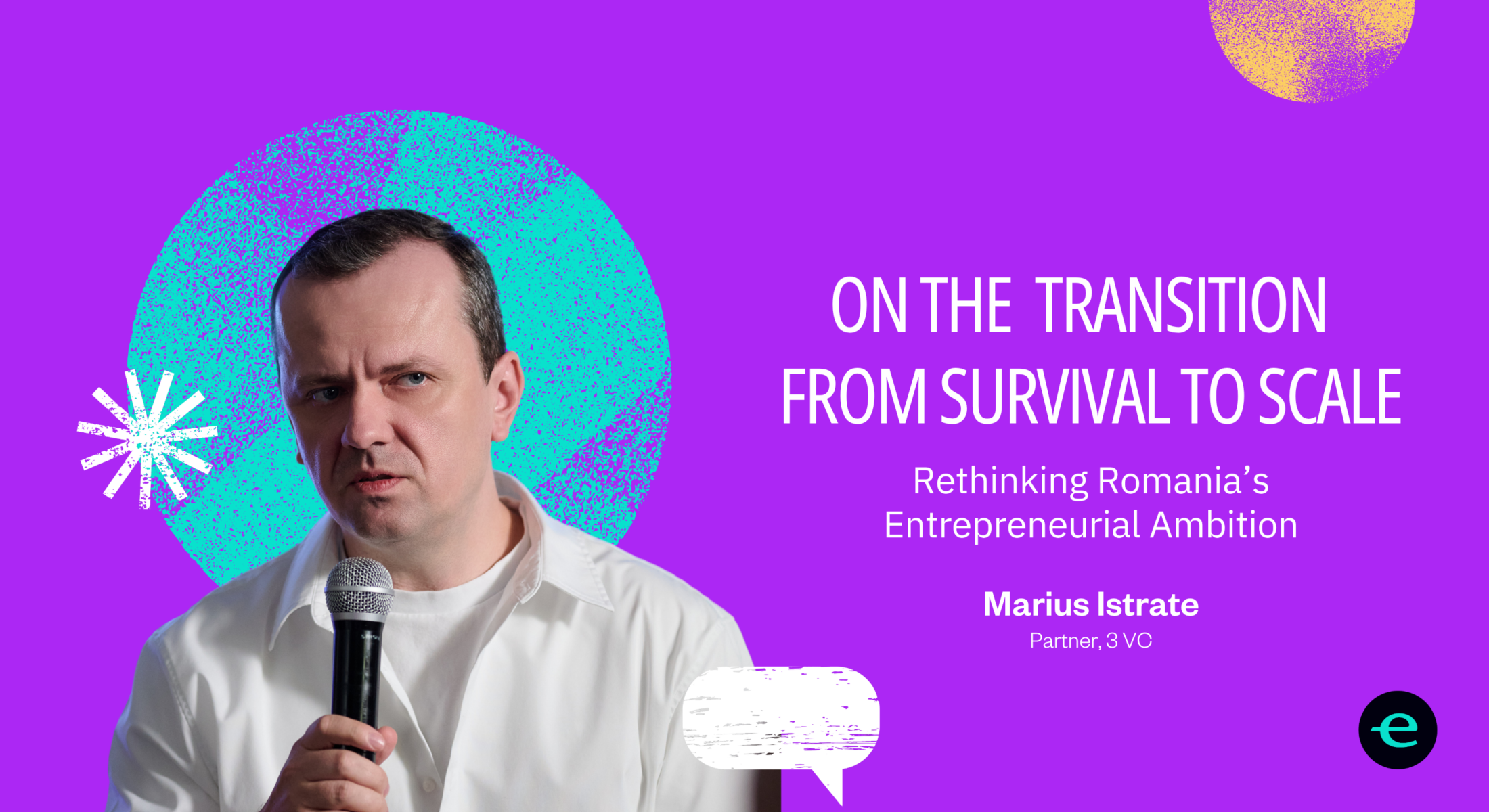
On the Transition From Survival to Scale: Rethinking Romania’s Entrepreneurial Ambition
Ten years ago, joining a Romanian startup with €1.5 million in seed funding was enough to make experienced people laugh. Today, Romania has a unicorn, more venture capital, and a much larger technology workforce than ever.
Marius Istrate lived through that change from inside UiPath and later as an angel investor and partner at 3VC. We asked him how much of it represents real progress, and what Romania still needs to build companies that matter globally.
Tell us about your experience.
I started as a software engineer, with a background in electrical engineering and computers. I worked in IT services and outsourcing, specifically in semiconductor and embedded engineering, and then in HR tech.
That is how I got to know UiPath, where I became Chief People Officer during the company’s early stages. Afterward, I became an angel investor and recently joined 3VC full-time as a partner.
You have experienced the technology industry as an operator, people leader, and now from the VC standpoint. Which of your beliefs about building companies have survived all of those transitions?
The one thing that has stayed constant throughout my career, and even before that, in my academic life, has been this feeling that I am living through the best period in human history at every point. I continue to feel that way.
It is one of the things that encouraged me to get into VC. In addition to living in the best period in world history, I also feel that this domain of activity, and VC investment in particular, gives you a window into the future. You understand what the possible futures are. We like to believe it gives us leverage; it actually does not, but it gives us at least an understanding of those possible futures. To the extent that we can put even the tip of a finger on the balance to help create a better future, that matters.
You have spoken about the importance of founders spending time in places where global companies are built. What changes when a founder enters a more mature ecosystem?
The mental leap you make as an executive or founder. When you go somewhere where money is more abundant, there is a higher chance that you will meet somebody who has both the money and the specific knowledge you need. Your chances of finding people to spar with and bounce your ideas off are higher in those places.
Everyone talks about Silicon Valley, but I do not think it is the best idea for everyone. If you are selling to financial or insurance customers, I highly recommend London or New York. If you are selling into aviation or defense in the United States, Seattle may be a better place. Every founder needs to identify the technology hub that matches what they are trying to achieve and where their potential customers and partners are.
Bucharest is not yet that place, although I am convinced it can become one. Right now, there is no harm in saying that Paris, Amsterdam, or London are better. That leap comes from having more conversations and being exposed to the people in those ecosystems.
Where do you see genuine progress in the Romanian technology ecosystem compared with ten years ago?
On all fronts, really. First, we have checked one of the most important boxes: capital availability. There are still things I find uncomfortable. Most VC funds here tend to raise at the same time because they are anchored by the EIF through the same programs. That means they also tend to reach the end of their fund life cycles around the same time, creating financing gaps that we feel more acutely here.
Even so, the money is here. There is much more early-stage venture capital than there used to be. We have also proven what is possible, and I am not talking only about UiPath. FintechOS, Druid AI, Deepstash and other companies have very different profiles, growth paths, and potentially very different exit scenarios. There is no single roadmap.
Ten years ago, when I told people in my professional life that I was joining a startup, they were rolling on the floor laughing. They thought it was the stupidest idea imaginable to join a company that had raised only a seed round of roughly €1.5 million.
The third change is the talent pool. Compared with ten or twelve years ago, there are roughly 100,000 more people working across technology and communications in Romania. The size of that pool creates opportunities for people to move toward activities with higher economic output.
To summarize: capital, talent, and the realization of what is possible are all here, and all three are important.
Many successful Romanian entrepreneurs were motivated by what they lacked growing up. Can a new generation with access to a more mature ecosystem develop the same drive?
Scarcity was not always an advantage. Sometimes it was, but many other times it dragged people down. When I think about the late 1990s and early 2000s, a great deal of time and energy was wasted on survival.
Scarcity teaches tough lessons, but my experience is that success is a better motivator than failure. I am biased by my experience at UiPath, but it is one significant data point in my life.
My motivation for joining UiPath was partly rooted in scarcity and in the feeling that something could be achieved even though almost nobody would have placed a bet on a company born in Romania. There was some frustration in it. Everything I built afterward was based on something else: the belief that there is a path to building something successful for the long term, on solid principles that do not have to come from frustration, spite, or scarcity.
France, Germany, and Sweden did not build their startup ecosystems out of scarcity. They were motivated by the intention to compete on the global stage and build generational companies. We do not need the trauma of the 1990s to push us forward.
We have a real chance to build something solid for the future and access to the same things as the Czechs, Poles, Swedes, and French. We do not have a handicap.
Do you think Romania, or perhaps the region more broadly, is developing a healthier relationship with success?
This is where our national psychology can drag us down, and it is not limited to Romanians. One thing is pervasive across the region: people care more about being right than about being rich.
That means: I will work to prove that I am right rather than to create economic prosperity for myself and those around me. It leads to choices that can look questionable in retrospect.
Being willing to accept that you may be wrong creates a stronger sense of collaboration. I would rather prosper by working with you and admit that you may be right than impose my point of view. We are not over this yet in our region.
Advice can help founders avoid expensive mistakes, but it can also push companies toward accepted patterns. How do you challenge a founder without making the company more conventional?
Working with investors is not as much about advice as people think. It is more about governance, and advice and governance are very different things.
Advice is part of a personal relationship. Governance is different. As an investor, I have a fiduciary responsibility to the people whose money I manage. I do not want control of the company; I trust the founder to lead. I can encourage them to think sanely about financial governance, their leadership team, and how they lead the business.
When we say that a company needs a CFO, that is not advice; it is a condition of sound governance. The same applies to regular reporting. Founders spend every day in the weeds and occasionally need to step back, look at the whole picture, and confirm whether they remain on the right track.
There is a rule I heard from another investor: when everything is sky-high, challenge the company and the founder. Is there a missed opportunity? Are we leaving money on the table? What could crack, and how do we keep the momentum?
When things are not going well, help, stay calm, and be supportive. If you have nothing useful to say, perhaps say nothing.
The most actionable thing you can give a founder is a framework for governance: why the company needs a CFO, why people should not be recruited on a whim, and how to maintain discipline in a fast-growing environment.
Why has Romania struggled to turn its global diaspora into a consistent source of market access, capital, and experience for founders at home?
Our relationship with the diaspora is quite neutral right now, though definitely less consequential than the relationship Polish, Bulgarian, or even Hungarian communities have with their diasporas.
We should not forget how some of the people now in the diaspora left Romania and what the Romanian state did. The violence of the 1990s convinced an entire generation of intellectuals that there was no place for them in Romania. I think they felt hopeless. Leaving your home country and everything behind in a state of hopelessness is traumatizing. It happened in the 1990s, but it also happened under communism.
Trust is rebuilt over a very long period. Some people in the diaspora now return and see that they sacrificed time with their families, while the gap they left for is no longer there. They may ask why they spent 20 years being treated as second-class citizens in another country. It’s important we try to understand how they feel.
In technology, the equation may be simpler. People left to work for great companies and built great lives. Today, you can also build a great life in Romania.
The relationship cannot be repaired by technologists alone. Romanian society needs to decide what relationship it wants with the four to six million Romanians abroad. It goes beyond bringing people home, they have built lives abroad and already left everything behind once.
You speak of a future Romania with ten unicorns. What can each of us in the ecosystem do today to make that happen?
Start with the simplest thing: let us each do our part. Founders should keep working on their companies and try to build the best thing they can. If one company does not work, move to the next one and continue. Investors should contribute money and knowledge where they can create value. The media and other spokespeople for the ecosystem should amplify the messages they believe matter.
For everyone else: talk about it. Some people discussed the ten-unicorn vision because they found it outrageous; others because it inspired them. A respected Turkish investor told me that Turkey had the same debate five years ago. At the time, it had one unicorn; now it has eight. He said it was absolutely possible and that being able to articulate the ambition mattered.
Looking back 20 years, when Romania joined NATO and the European Union, prosperity can appear almost inevitable. Starting from where we were, it now seems as if prosperity followed naturally. There is an element of that in this vision. From where Romania stands today, economic prosperity is within reach, and so is the creation of more valuable companies in a field where we are already good: IT and communications.
Building ten companies worth at least a billion dollars is not inevitable, but the probability is higher than Romania creating the next Louis Vuitton. That is the baseline reality, and it is why the vision matters.
Will the Romanian technology ecosystem eventually need to bring the state into what it is building?
When I took over TechAngels in 2023, I proposed working with the Romanian public sector. Some colleagues said it had failed before: we go to the United States and the United Kingdom anyway, so why should we care?
My answer remains that if we do nothing, we cannot have expectations. After three years of working with the state, I did not encounter ill intent. People were unaware of what the sector needed and why it mattered.
Somebody has to create the opportunity for dialogue. Our Bulgarian colleagues persisted for 12 or 15 years, building relationships in parliament and explaining why particular issues mattered.
Romania is beginning to see the results of collaboration among Romanian Business Leaders, ROPEA, TechAngels, ANIS, and others. We are not perfectly aligned on every topic, but we have found ways to create dialogue with the public sector.
A practical example is the business angel law passed in 2015, which never received implementation norms and was therefore unenforceable. We now have provisions that clearly define business angels, how they invest, the relevant fiscal limits, and ownership thresholds.
That could not have happened without an open channel of communication with the authorities. Bulgaria may have a hundred examples like this and Romania only a couple, but we are building them.