Dream Bigger, Out Loud: Five Years of Endeavor Romania and Linda Rottenberg’s First Visit in Bucharest
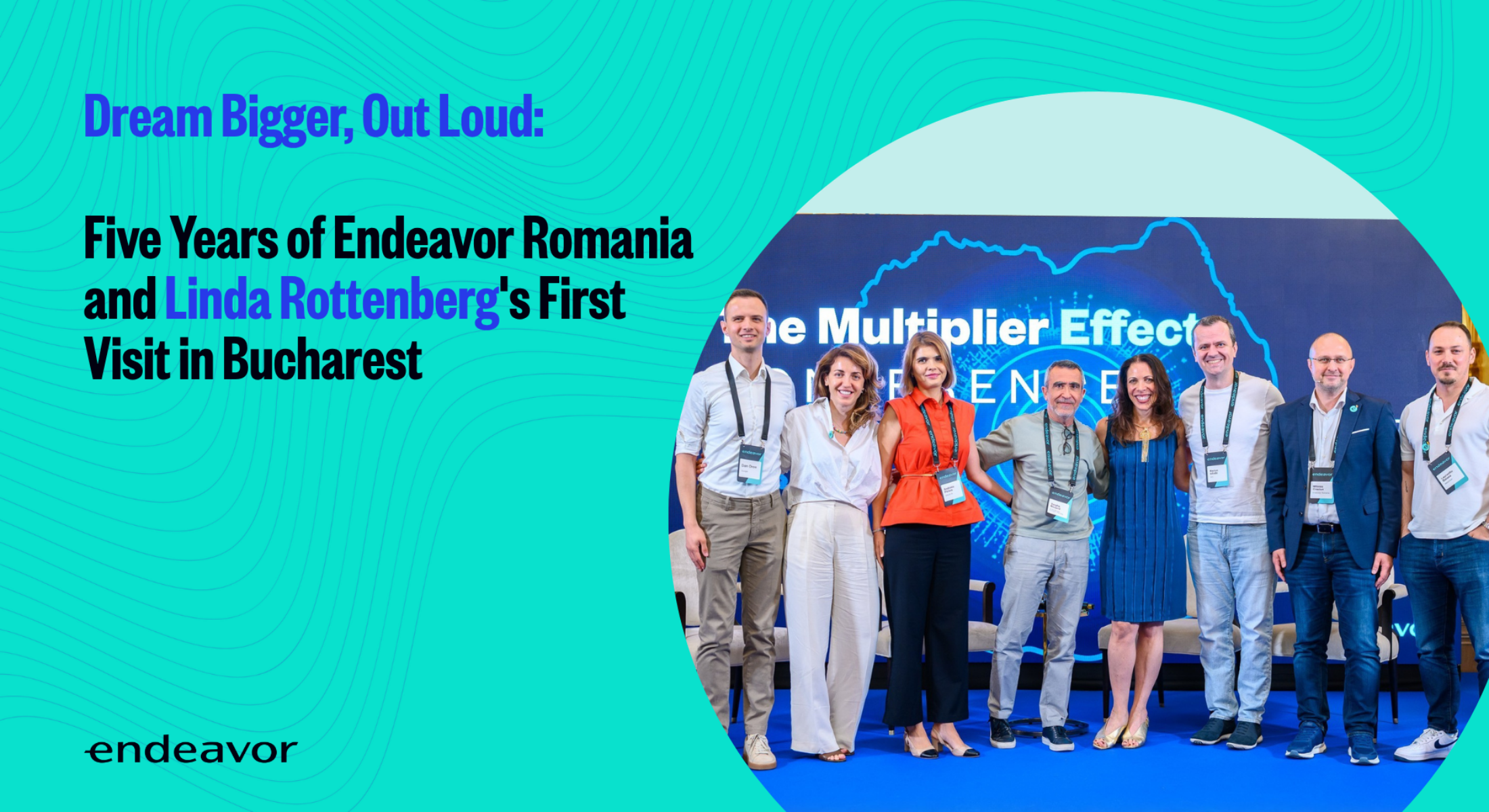
There is a particular kind of silence that falls over a room when someone who built something from nothing starts to talk about how it began. It fell over Bucharest this month, when Linda Rottenberg, the woman who co-founded Endeavor in 1997 and has spent almost three decades convincing the world that great companies can come from anywhere, sat in the same room with Romanian founders, board members, and friends of Endeavor Romania to celebrate five years of work in this country, and her first-ever visit to it.
Five years go by quickly. But it is long enough to ask what the work was actually for, and long enough to earn an honest answer.
Where it all began
Endeavor’s founding story has become part of entrepreneurial folklore for a reason: it is simple, and it is stubborn. Linda Rottenberg was a young graduate student when she noticed something that seemed obvious once she said it out loud: talent is distributed evenly across the world, but opportunity is not. Brilliant people were building extraordinary companies everywhere from Buenos Aires to Nairobi to Jakarta, yet almost none of the attention, capital, or credibility that Silicon Valley took for granted ever reached them. So she and her co-founder, Peter Kellner, made a simple bet: that if you find exceptional entrepreneurs early enough, surround them with the right people, and stay with them as they grow, they’ll build companies that change far more than their own businesses.
That bet has since become a global movement. Endeavor now works in more than fifty markets. Its screening process is famously unsentimental: out of well over a hundred thousand companies reviewed worldwide, fewer than three thousand founders have ever been selected as Endeavor Entrepreneurs. Those who make it gain access to something that used to be nearly impossible to buy, a network of people who have already lived through the specific, lonely problems of scaling a company past the point where local playbooks stop working. Through Endeavor Catalyst, the organization also became one of the most active early believers, outside the United States and China, in the founders who would go on to build billion-dollar companies. The results carry their own weight: millions of jobs and tens of billions of dollars in capital raised by companies that came through the network, all built on a philosophy compact enough to fit on a wall: “Dream Bigger. Scale Faster. Pay It Forward.”
A young chapter, already showing its shape
Romania’s own Endeavor story began quietly, in conversations that, by the account of the people who had them, nobody was entirely sure would lead anywhere. It launched officially in 2021, led locally by Mihnea Craciun, at a moment when the idea of a Romanian founder being selected into the same global network as entrepreneurs from São Paulo or Lagos still felt more aspirational than realistic.
Five years later, the shape of the bet is visible. Five Romanian companies have passed Endeavor’s global selection process, joining the network as full Endeavor Entrepreneurs. Sixteen more have gone through Scale Up by Endeavor, a program built specifically to connect fast-growing Romanian tech founders with mentors who have already scaled internationally, shortening a learning curve that once took founders years to navigate alone. None of this happened because Romania suddenly discovered ambition it didn’t have before. It happened because someone built a bridge to a network that already existed, and enough founders were willing to walk across it.
The gap nobody quite wants to name
And yet, if this month’s gathering had one honest, slightly uncomfortable thread running through it, it was this: Romania has already built companies capable of changing their industries, and most of the world still has not noticed. Global investors, as a rule, follow attention as much as they follow returns, and their mental map of where innovation happens has not caught up with where it is actually happening. Funding is only part of the equation. Visibility matters just as much, and it grows when countries consistently tell the stories of their founders, celebrate their successes, and show up in the conversations that shape global markets.
The uncomfortable part is that this reticence sits somewhere close to a genuine Romanian virtue, a distaste for boasting, a preference for letting the work speak for itself – that has quietly curdled, in enough founders and enough pitch decks, into something closer to invisibility. Humility and self-diminishment are not the same instinct, even though they can look identical from the outside. A founder can be proud of what they built and still listen carefully to the room. What doesn’t serve anyone is presenting a genuinely global company as though it were a modest local success story, and then being surprised when investors treat it as one.
Building the next unicorn means training a muscle
The founders who spoke this month kept returning to a version of the same idea: ambition at scale is less an innate trait than something that develops over time. Like any muscle, it grows through repetition, exposure and, perhaps most importantly, proximity to people who have already built companies on a much larger scale. Founders who spend meaningful time inside more mature ecosystems come home with a recalibrated sense of what is possible. That kind of immersion tends to matter far more than a few days spent moving from one conference conversation to the next. Scaling faster, in this telling, is really about learning faster, shortening the distance between a mistake and the correction, rather than simply producing more of the same problem at higher volume.
This is also why programs that physically move Romanian founders into rooms with people who have already scaled internationally, through Endeavor, through Scale Up, through initiatives that will soon take founders to ecosystems like Madrid, matter more than they might sound like on paper. They are attempts to shorten the distance between what a founder assumes is possible and what actually is.
Say it louder, and mean it
If there was a single message that Linda Rottenberg brought with her on her first trip to Romania, the founders in the room seemed to agree it was this: build companies that change industries, and then have the confidence to say so, on stage, without apologizing for it. Because the world doesn’t discover great companies by accident. Every founder in Romania who stands on an international stage and tells an honest, ambitious version of their company’s story makes it a little easier for the next one to be believed and every success that stays quiet is a door that stays closed for someone else.
The village, and what it leaves behind
Perhaps the most lasting idea from this anniversary was about what a company is actually for once it succeeds. A great company is measured by the people who pass through it and go on to start the next ten companies, invest in the next hundred, mentor the founders who come after them, and carry forward standards they learned nowhere else. A unicorn is an important milestone for any ecosystem. Real maturity comes when that unicorn has left behind enough people capable of building the next ones, a village, in the truest sense, where success is not hoarded but handed forward.
That is the quiet promise underneath five years of work, and underneath one long-awaited visit: Endeavor Romania was and is in the business of building the conditions under which Romanian founders stop asking for permission to dream at scale, and start giving each other a reason to believe it’s already happening.