Building Without Boundaries: A Conversation with Prajna Khanna from Prosus
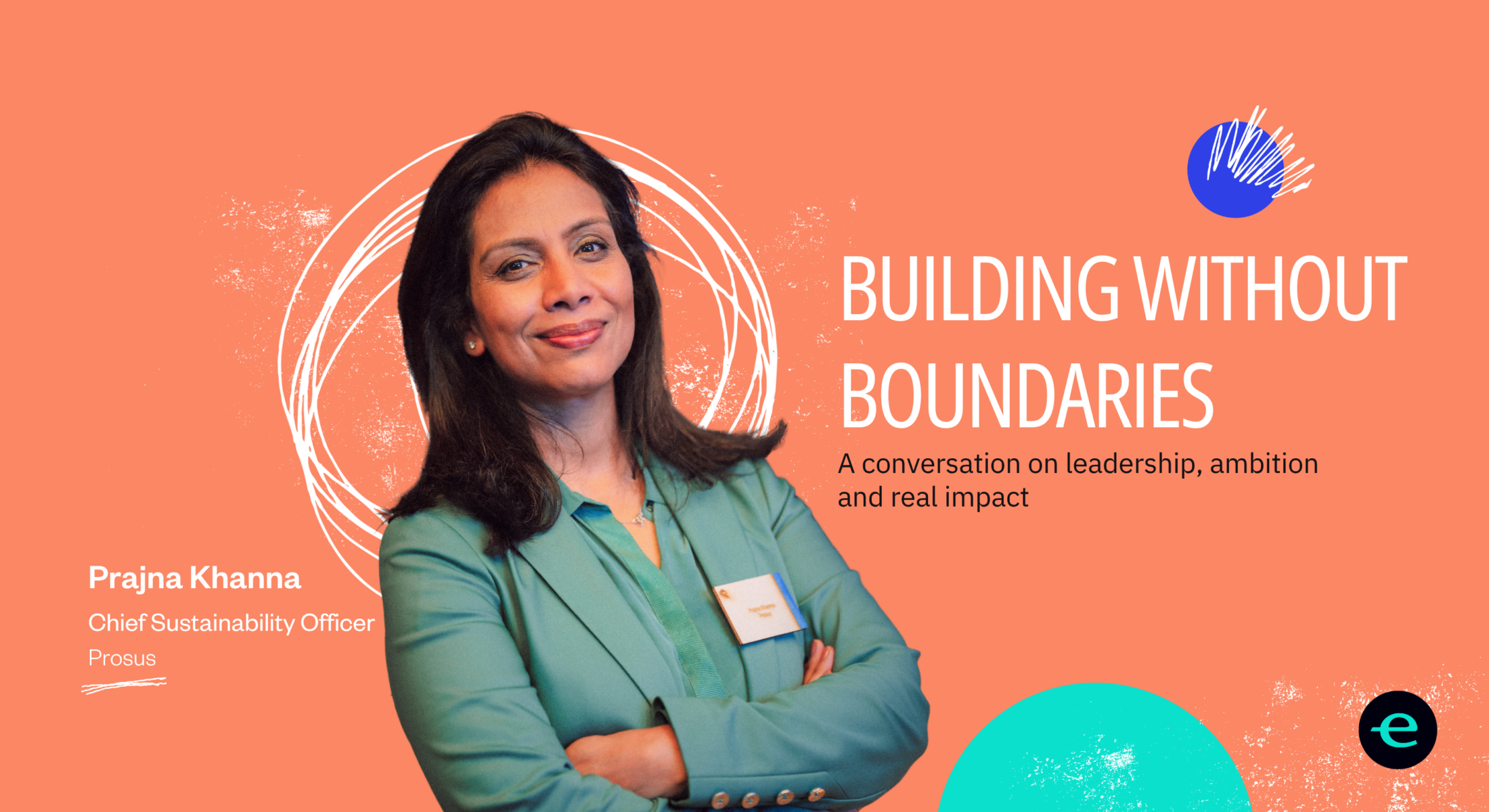
Access to capital remains one of the most visible challenges for women founders. Less visible are the questions that come before and after it: what gives someone the confidence to build a company in the first place, what encourages them to take the leap from technical expertise to entrepreneurship, and what kinds of support help founders continue scaling once the business is underway. As Chief Sustainability Officer at Prosus, Prajna Khanna has spent years working at the intersection of technology, entrepreneurship, and impact across emerging markets. Through the Prosus Found-HER Challenge, she has also worked closely with women founders building AI-native and deep-tech companies across India, Africa, Romania, and beyond.
In this conversation, she reflects on why we often place limits on ourselves before the market ever does, what she has learned from working with ambitious founders across continents, why confidence and networks matter as much as funding, and why the most important transition a founder can make is separating their identity from the company they are building.
The conversation follows the Romanian edition of the Prosus Found-HER Challenge, organized by Prosus in partnership with Endeavor Romania to expand access and opportunities for women founders.
Instead of revisiting your career journey, let’s start with something a little more personal about yourself.
One thing that has probably defined me throughout my career is that I’ve never put myself into a box. I’m a trained filmmaker who has worked in banking, then in technology at Philips, and now at Prosus. I’ve pivoted multiple times throughout my career, and I’ve never felt that there were things I couldn’t do simply because they weren’t part of my background.
We live in a world that values specialization, which is important. But sometimes, in the process of becoming specialists, we create limitations for ourselves. We tell ourselves “This isn’t in my wheelhouse”. I’ve never really subscribed to that way of thinking. Anything can become part of your wheelhouse if you’re curious enough and willing to learn.
You seem to be someone people turn to for advice and support. Does that ever become overwhelming?
It absolutely does, and I’m still learning how to manage it. Earlier in my career, when I was beginning to move into more senior roles, I found it incredibly energizing when people reached out. I’d happily have coffee with them, share experiences, make introductions, and see how I could help.
Today, I still want to do that, but the volume has become much greater. I have a demanding job, I’m also a mother. What has become difficult is the feeling that I should always be able to show up with the same level of energy and commitment for everyone who reaches out. When I can’t, I feel guilty. I’m still working on that.
Through the Prosus Found-HER Challenge, you’ve worked with women founders across different markets. What have you learned so far?
The initiative started with a very simple question. A little over a year ago, some of the younger people in our company kept asking me why we weren’t seeing more women founders in our portfolio. So I went to our leadership team and essentially said: let’s find out.
What I’ve learned since then is that there is no shortage of women building innovative businesses. I’ve met women founders across India, Africa, Romania, and now other markets who are building AI-native companies, deep-tech businesses, and highly ambitious ventures. The challenge is not a lack of talent or a lack of ideas, but that women remain significantly underfunded.
The more I’ve looked into it, the more I’ve realized that this is a deeply structural issue. We often talk about pay gaps and representation gaps, but the funding gap is equally persistent. Even when women are building highly investable companies, access to capital remains disproportionately difficult.
I genuinely believe this is a problem that will take a long time to solve. It’s not as simple as saying that the best ideas automatically get funded. The reality is much more complex than that.
As AI becomes more accessible, where will lasting competitive advantage come from?
When we talk about AI, we often speak about it as though it’s a single phenomenon. But there are multiple perspectives to consider: are we talking about the people building the models? the people deploying the technology? the people benefiting from it? the people whose lives will be transformed by it?
Those are very different conversations. What fascinates me is how this might play out across emerging markets. Historically, we’ve seen emerging economies leapfrog entire generations of technology.
Take India. Large parts of the population moved directly into mobile-first digital services without going through many of the intermediate stages that developed economies experienced. We’ve seen similar patterns in payments, telecommunications, and access to information.
AI may create similar opportunities, but we’re still very early in the cycle. The promise is enormous, and we haven’t yet seen the full extent of the transformational impact people are predicting.
Romania has one of the highest shares of women working in technology in Europe, yet relatively few become founders. Why does that gap still exist?
That’s a fascinating observation, and honestly, Romania is similar to other emerging markets in that respect.
In India, for example, there are many women graduating from engineering schools and entering technical professions. But significantly fewer make the leap into entrepreneurship.
The question I find interesting is: what happens between those two stages? What are the conditions, experiences, or influences that encourage some women to step into entrepreneurship while others do not?
Now that we’ve worked with women founders across multiple markets, we have an opportunity to look for common patterns. Are there shared personality traits? Similar life experiences? Specific support systems? Certain moments that pushed them to take the leap?
I suspect the answer is more nuanced than any single explanation.
Have you noticed any common characteristics among the women founders who are gaining momentum?
The first thing that stands out is how young many of them are. Whether I look at the founders we’ve met in Africa, India, or Romania, I’m constantly impressed by their willingness to take risks at an early stage in their careers.
The second thing I’ve noticed is that many of them are building businesses that combine commercial ambition with a broader sense of purpose.
If I think about the women we met in Romania, for example, they were working on challenges related to healthcare, recruitment, sustainability, and other areas where the business model and the societal impact are closely connected. That doesn’t mean they’re not commercially driven, they absolutely are. But many of them seem motivated by a desire to solve a problem that matters, not simply to optimize an existing process.
Beyond access to capital, what forms of support would have the greatest impact on helping more women founders scale?
Capital is obviously important, and sometimes I worry that when we say “beyond capital” we risk underestimating how significant that challenge still is. Women need access to funding.
At the same time, there are other forms of support that matter enormously. The first is confidence. We need to help women continue believing in themselves even when things don’t go perfectly. Too often, women feel they need to be fully prepared, fully qualified, and completely certain before they take a step forward. Entrepreneurship doesn’t work that way. You have to be willing to make the pitch before everything is perfect. You have to be willing to fail, learn, and try again.
The second thing is networks. Men have traditionally been very effective at supporting one another through professional networks. They make introductions, recommend each other, open doors, and create opportunities. Women need to become equally intentional about doing that for one another.
You spend a lot of time thinking about diversity and inclusion. What have you learned about why progress can sometimes feel so slow?
One realization I’ve come to over the years is that inclusion isn’t something you switch on when you enter the office and switch off when you leave. You’re either inclusive or you’re not.
Organizations can run diversity programs, unconscious bias training, mentoring initiatives, and all sorts of interventions. Those things matter. But if the broader society around them isn’t changing as well, progress will always be limited.
That’s why this conversation has to extend beyond companies. It has to involve schools, communities, families, sports, and all the environments where people form their assumptions about themselves and others.
If you could change one thing about the way we support ambitious founders, what would it be?
The biggest thing I would encourage founders to do is separate their identity from their company. Your company is something you build, and it should not take over your identity entirely. Before being a founder, you were already a person, and after it, you will still be a person.
We already know that most startups don’t succeed. That’s simply the reality of entrepreneurship. If founders make the company their entire identity, they’re putting themselves in an incredibly vulnerable position.
Success is a combination of factors. It’s talent, effort, timing, opportunity, the people who support you, the people who recognize your potential, and sometimes simple luck. Recognizing that creates perspective, and that perspective makes people better leaders, more empathetic colleagues, and ultimately better members of society.
What advice would you give a founder with global ambitions today?
Don’t create limitations in your own mind. Too often, founders assume they can only build for their local market or that their background somehow defines the scale of what they can achieve.
The reality is that meaningful problems exist everywhere. If you’re solving a real problem and creating genuine value, there is no reason to think only within the boundaries of your geography.
And above all, don’t operate from fear. The worst outcome is that an idea doesn’t work, and that doesn’t mean you failed as a person. It simply means that one idea didn’t succeed. Then you pick yourself up, learn, adapt, and move on to the next one.
The Prosus Found-HER Challenge is an initiative brought to Romania by Prosus and Endeavor Romania to expand access, visibility, and support for women founders building the next generation of technology companies. Learn about the inspiring women who won the Romanian edition here.