How to have more women founders? Normalize ambition early
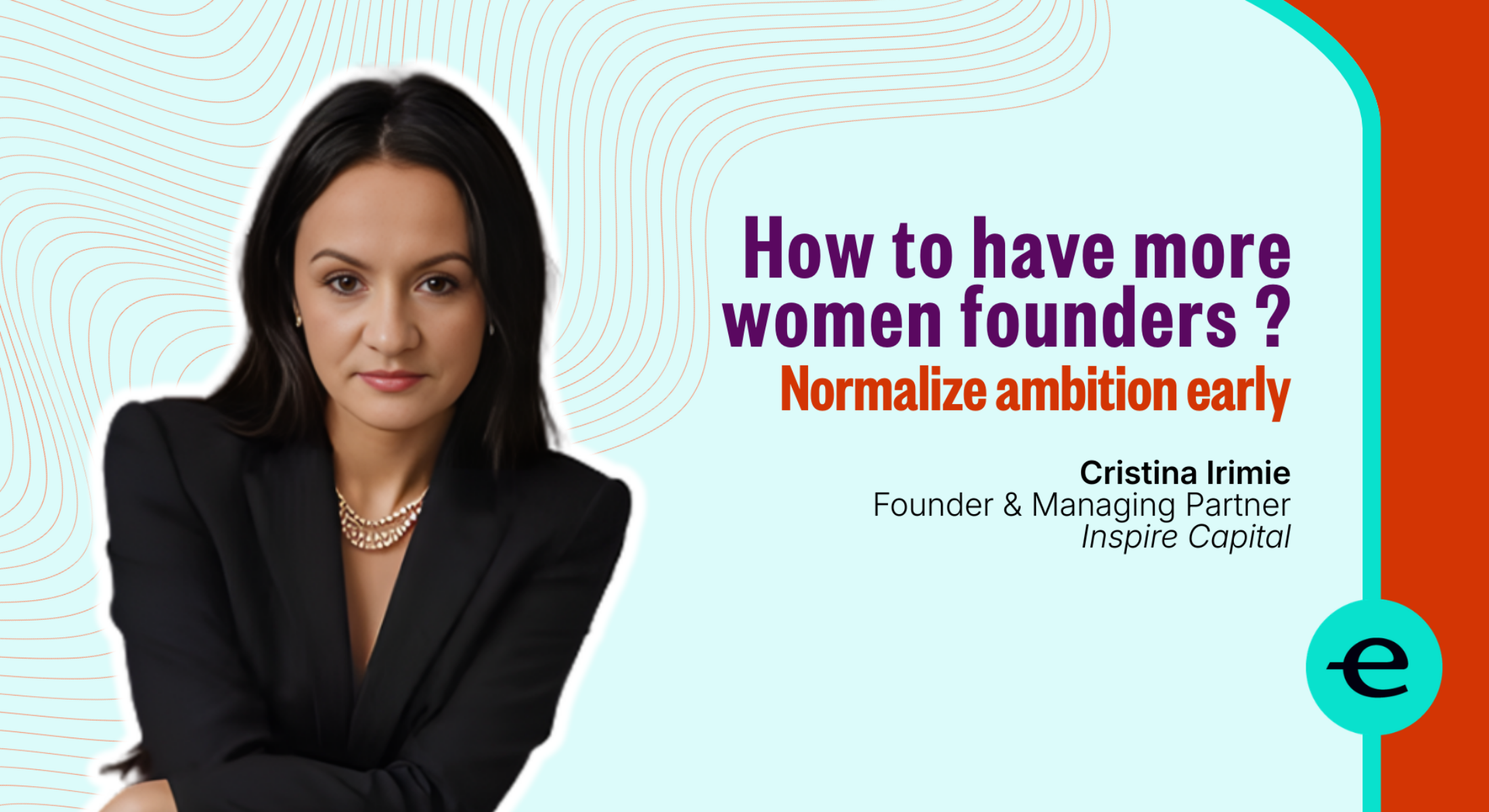
By the time a founder raises capital or builds a company, most of the invisible groundwork behind that decision has already been laid. This story is about that groundwork.
Much of the real inspiration for present and future entrepreneurs lies closer to home, as Cristina Irimie, Founder and Managing Partner of Inspire Capital, a family office venture fund from Romania, notes. She is an experienced finance executive turned venture capital investor, with a career spanning over 20 years across banking, automotive (CFO/COO), and early-stage investing.
You can find inspiration in the women who build companies while raising families, who sit at negotiation tables and remain composed when pressure escalates, and who influence decisions without needing to dominate the room.
Their leadership is defined by resilience, clarity, and the ability to move things forward with steady conviction.
“The ability to think beyond one market, from day one, is what turns local ideas into global impact in education and in venture alike”, Cristina told us.
Influence is not noise
For her, as for many women in business, inspiration comes less from celebrity and more from proximity, from witnessing how other women navigate complexity with calm determination.
These are leaders who balance ambition with responsibility, who build teams, close deals, and solve problems while managing the invisible demands that often accompany their professional lives.
Their example shows that influence does not always arrive with noise, but with consistency, preparation, and the quiet confidence to stand firm when it matters most.
Role models that open minds
One of the role models that helped Cristina have a broader perspective on impact is Sofia Corradi, often referred to as the “mother of Erasmus”. What makes her legacy inspiring is not simply the creation of a program, but the conviction behind it. She believed deeply that exposure to different cultures changes how people think, collaborate, and lead.
“She understood that tolerance, intellectual openness, and cross-border dialogue are not abstract ideals; they are built through real human experience. And exposure to different cultures doesn’t just broaden minds, but it fosters empathy, reduces prejudice, and over time creates a more peaceful and interconnected world, a conviction whose relevance feels undeniable in the world we live in today”, Cristina Irimie explains.
A growth mindset
When it comes to Romania, Cristina is convinced that our ecosystem is developing an increasingly strong pipeline of female founders. Across industries, more women are stepping into entrepreneurship not only with bold ideas, but with the expertise and persistence required to build lasting companies.
“The next wave of impact will not come from easy markets, it will come from founders who choose hard problems and stay with them”, Cristina states, convinced that if there were one action with the potential to increase the number of women entrepreneurs in Romania almost immediately, it would be to normalize ambition early.
Not extraordinary, but natural
The way entrepreneurship is framed in schools, in families, and in the media has a profound influence on how young people imagine their future.
“If a girl grows up seeing entrepreneurship as a viable path and not as something “extraordinary” but as something natural, the pipeline changes dramatically within a generation”, is her belief.
For young women just beginning to imagine their future, the most valuable advice Cristina would give, may be surprisingly simple: build competence before you build confidence.
“Focus first on becoming genuinely good at something, learn deeply, develop skills, understand your field, put in the work”, says Cristina.
Confidence built on true capability is resilient, it does not disappear when challenges arise. And while a résumé will always highlight successes, the deeper lessons that shape a career often come from what did not work.
Those experiences, whether we’re talking about the experiments, the failures, the adjustments, are what ultimately build judgment, resilience, and long-term leadership.