Mariana Gheorghe: “we’re no longer talking about the genius in the garage. You can’t do it on your own, you need collaboration”
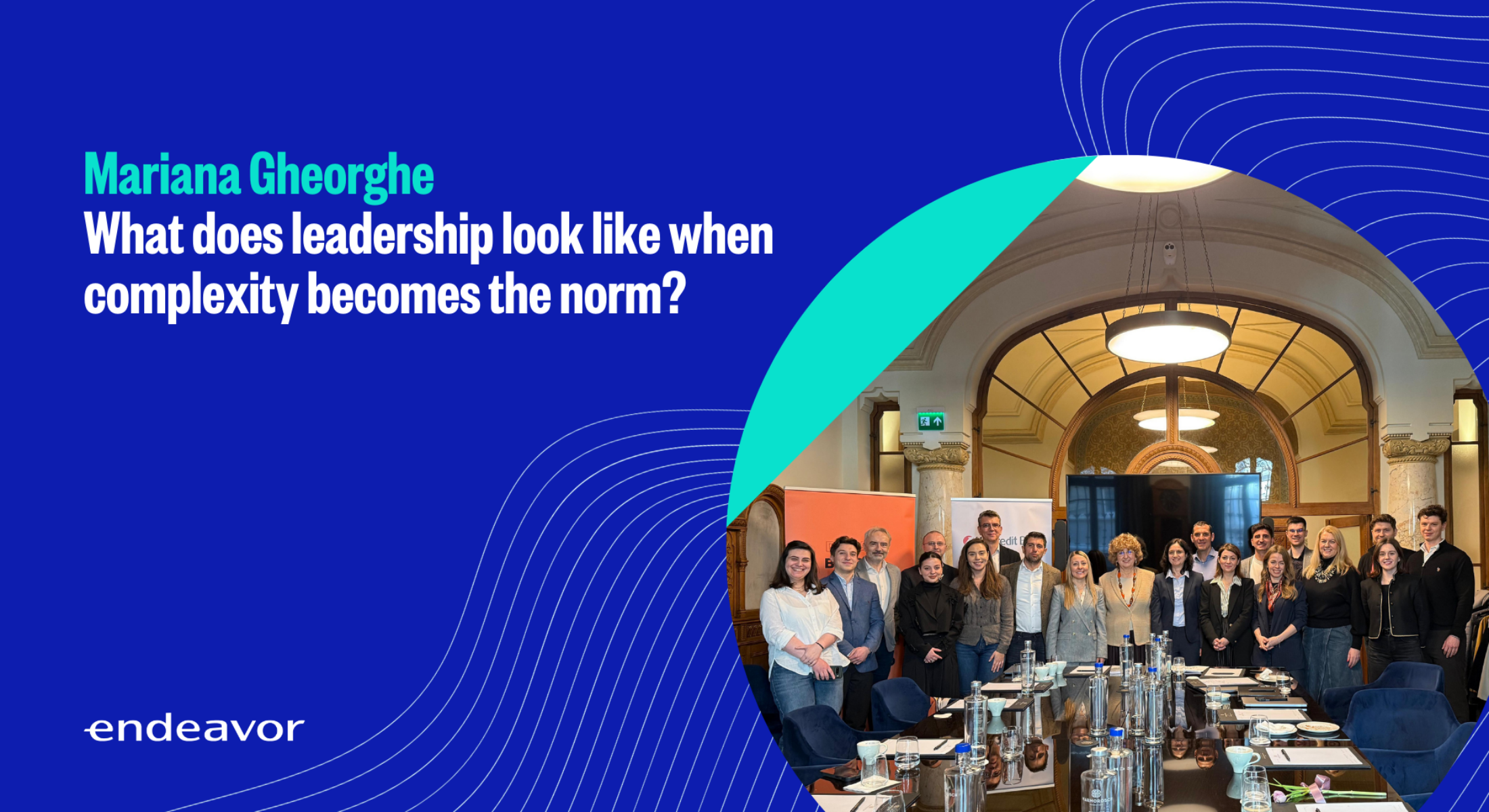
What does leadership look like when complexity becomes the norm?
At our latest Business Breakfast, we had the privilege of hosting Mariana Gheorghe, one of the most important business leaders in our country in the last 35 years, for a conversation with founders about scaling companies, navigating uncertainty, and the realities of leading through periods of transformation.
“My mission for the next 10 years is to help Romanian leaders flourish”, Mrs. Gheorghe stated during our second Business Breakfast of 2026.
With a career that included over a decade at the helm of OMV Petrom, international experience at the EBRD and multiple executive and non-executive roles in boards and educational organizations, Mariana Gheorghe brings a rare perspective on how to build sustainable performance and how to shape the next generation of leaders.
In recent years, she has been actively involved in developing the next generation of leaders, being co-founder of the Future of Leadership Institute, an initiative dedicated to research and leadership training in the context of new economic and technological transformations.
Scaling, but for leaders
A few ideas stayed with us from the conversation with Mariana Gheorghe, as she gave the founders and us personal examples from her extensive career as the leader of some of the largest financial institutions and companies from our country and beyond Romania’s borders.
First, the distinction between managing and leading. Mrs. Gheorghe is a true believer in the concept of scaling the leader. In translation, as a leader, you have to know yourself and lead yourself in order to know others and lead them.
As she reflected, “for the first two years I was a CEO, not yet a leader”. Leadership emerged over time, once trust was built, difficult decisions were taken, and the organization began to align around a clear direction.
Second, the reality that growth multiplies complexity. As companies scale, leaders move beyond operational challenges and begin navigating a broader system of stakeholders, expectations, and long-term consequences.
No more geniuses alone in garages
And perhaps the most resonant idea of the morning: businesses are citizens of society, be it corporate citizens. This means that they don’t operate in isolation, and their impact extends well beyond financial results.
“You can’t do it on your own, without collaboration. We’re no longer talking about the genius in the garage. Even those companies transformed nowadays into corporations. No matter the impact, you can’t do it in isolation”.
She outlined the leadership framework she works with, built around five dimensions: vision, agility, community, sustainability, and social impact. As companies grow, leaders are expected to balance all five simultaneously, far beyond the operational focus of the early stages.
Another idea was also emphasized: that leaders rarely have an objective, 360° view of themselves when assessing their own performance.
“We have blind spots when we’re looking at ourselves, as founders, as managers. That’s why there’s always a good idea to ask for feedback from the people around you. They’re seeing us from different angles”.
In her opinion, honest feedback from the people around them becomes essential for any leader who wants to evolve.
Constant learning, the mark of a true leader
Mrs. Gheorghe also discussed some key elements that helped her stay grounded during inflection moments in her career. “I always found motivation in constant learning. My curiosity and willingness to learn helped me in inflexion points in my life. And I always chose positions where I knew around 50-60% of what the job required me to do. And I constantly learned on the job what I didn’t know when starting. We always have to learn, to be better”.
Technology, she noted, is the defining paradigm shift of our time. But the responsibility for leaders remains the same: to understand not only what they are building, but the wider impact it creates.
“I truly believe that when we’re talking about the greater good, we’re talking about staying human and the impact we have in other people’s lives. Not to care will come back as a boomerang against us”, Mariana Gheorghe reflected at our Business Breakfast.
The Endeavor Breakfast Series
These are monthly sessions focused on a specific area where founders consistently encounter blind spots once their companies begin to expand: how culture evolves during rapid growth, how product and engineering functions must adapt to new levels of complexity, what disciplined growth execution looks like, how diaspora experience informs market entry, and what legal and governance requirements become unavoidable as companies mature.
The format is simple. We invite operators, investors and legal experts with direct experience in these matters, and we facilitate conversations that allow founders to test their assumptions, compare approaches and understand the consequences of decisions made early.
The discussions are practical and often highly technical, covering issues such as the minimum conditions for market-readiness, the distinction between early growth tactics and scalable models, or the documentation required before entering a fundraising process.
What has become increasingly clear to us is the value of curating spaces where founders can speak openly about the challenges that rarely surface in public forums – creating a network of trust. The Breakfasts offered a setting where they could compare experiences and understand that many of the difficulties they face are shared rather than isolated. That sense of openness creates a sense of unity and camaraderie so necessary in entrepreneurship, especially coming from emerging markets.
We are grateful to UniCredit Bank Romania for supporting the Endeavor Breakfast series.