Growing a Network of Trust From an Emerging Market
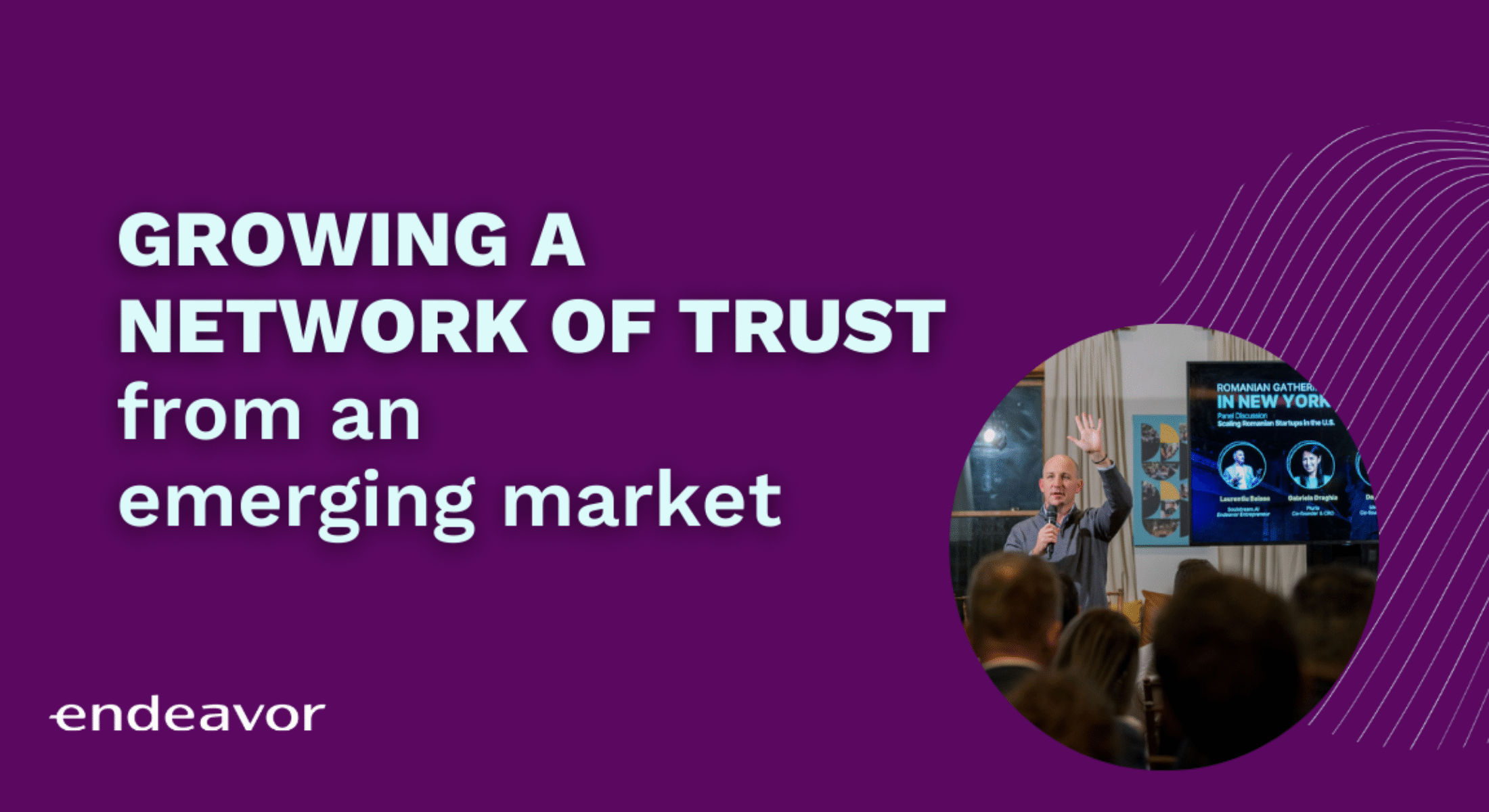
This year, we’ll celebrate 5 years of working alongside companies scaling beyond their home market. Staying close to entrepreneurs through that journey has given us a clearer read on where founders reliably get stuck, who helps them get unstuck, and the intersections where relationships turn into leverage when the stakes increase.
From Romania, the path to scale is still fairly demanding. A company might have product, talent, and early traction and still lose months in avoidable loops: rebuilding the same operating knowledge that already exists elsewhere, negotiating credibility from scratch in every new room, or hiring too late because the right senior people never entered the orbit early enough. These frictions surface across every business-critical node from customer negotiations to governance conversations.
Trust in people, processes and the ecosystem narrows the distance between a founder’s problem and someone who has already solved a version of it, and it improves the quality of capital conversations by making expectations informed.
But a network of trust is not built in a day. Multiple layers of the ecosystem have to come together and speak the same language, without pretending they have the same incentives. Founders carry the day-to-day pressure of execution, operators have scar tissue from scale: hiring, systems, international expansion, governance, the unglamorous work that determines whether momentum survives growth.
At the same time, investors bring pattern recognition shaped by other cycles and other markets, and they sometimes set the standards a company will later be measured against. Family offices and long-term private capital sit on a different calendar and tend to engage through governance, patience, and conviction rather than pace. Corporate leaders and senior executives understand procurement realities, decision chains, and how credibility is assessed inside large organizations. Global mentors add perspective that local ecosystems often lack, especially around expanding into markets where failure is expensive and competition is unforgiving.
When these groups remain separated, founders spend unnecessary time translating themselves: they explain basic context repeatedly, relitigate early questions at later stages, and learn through trial-and-error what could have been assimilated through proximity. Sustained dialogue has the unique power to create common reference points: what “ready” looks like.
That is one connective tissue we’re working on building, a set of repeated interactions designed to make expertise and access circulate more reliably, at a better cadence.
Can Isolated Progress Inspire?
A common feature of emerging markets is that progress often happens in pockets. A founder figures something out, an investor learns a lesson, an operator develops a strategy, and the knowledge stays local to that pocket. Then the ecosystem pays the same tuition multiple times, which can slow companies down and narrow ambition, because founders calibrate their plans around what they can safely execute with their immediate context.
What changes that pattern is sustained exposure to people who have lived through the consequences of scaling decisions. It is hard to build this kind of continuity by accident, and in fairness it’s not easy to build it intentionally either, as it takes a certain degree of maturity, deliberate convening, and a willingness to keep conversations open across stakeholder groups that don’t always sit at the same table.
Scaling and the Cost of Ambiguity
As teams expand and markets multiply, whatever informal alignment worked at a smaller level will have to be recalibrated for scale, where the company identity stretches thin and every digression is seen through a magnifying glass.
We saw this clearly in the feedback from our first Scale Up Program cohort. Bogdan Nicoară, Founder and CEO at Bright Spaces, focused on exactly this: “I personally got more clarity throughout the program, which automatically translated into more clarity in my team and with my investors and clients.”
Working with scaling companies has reinforced a simple lesson for us: outcomes improve when founders have access to the right mirrors (magnifying or not) early enough, while options are still open and reversals are still possible.
Setting Up the Proverbial Table
Global access is often misunderstood as a benefit you “get,” when it behaves more like a muscle the entire network develops, that grows through repeated, high-signal interactions where both sides find value.
This is also where emerging markets can contribute back rather than simply receive. Founders who learn to operate under constraint often develop a particular rigor around efficiency, resilience, and prioritization. When they engage globally as peers, the network becomes more balanced and more durable. Over time, it becomes easier to introduce Romanian founders into senior circles because the work they do and the way they do it feels legible.
One of the most consequential shifts we have tried to support is broadening who is considered part of the “startup ecosystem.” Venture capital and founders are important, operators matter, boards matter, and so do corporate networks or family offices, especially in an environment where venture cycles can be volatile and where patient involvement can influence governance, discipline, and staying power.
These stakeholders already exist. The challenge is that they often sit outside the typical circuit of startup storytelling, and they rarely get integrated into the same ongoing dialogue. When founders only meet them late, the relationship begins under pressure, with misaligned expectations.
Dan Huru, Co-founder at MeetGeek.AI and participant of our current Scale Up Program cohort put it simply: “You always need to get a mix between a good network and a good execution framework… to have meaningful conversations and to open doors that you wouldn’t be able to open without getting out of your comfort zone.”
What’s Next?
We’ve learned that true leverage lies in helping founders access experience that’s immediately applicable, in keeping multiple layers of the ecosystem in active conversation, and making global peer learning easier to activate.
From the outside in, from mature markets, this can look like a sisyphean task, but we’ve learned it becomes easier to accomplish through consistency, standards that hold under pressure, and the willingness to keep convening people.